Modus Ponens and the Formally Valid Fallacy
A lot of what is taught in the universities goes back to the medieval Middle Ages when Greek and Latin were more common. Modus Ponens is Latin, and it means “Means of Affirming. I guess, if you want to be an egg-head, you have to learn these terms. As for me, I’m not into memorizing strange language, but I do want to know what makes sense and what doesn’t make sense. I have learned that an argument isn’t always two people disagreeing. There’s another meaning. If someone is trying to make a case, it’s called an argument. That person is presenting an argument. Generally, the person will make one or more claims (called premises) to support another claim (called a conclusion). It’s really not as complicated as they try to make it sound.
The formally correct fallacy (formally valid fallacy) is a mistake in thinking. This mistake is common. You can see it everywhere all the time. It’s the idea that if the form of the argument is valid, the conclusion must be true. The problem is that the premise hasn’t been proven. The premise isn’t true.
If any premise in the argument isn’t true, the logic isn’t sound. If the form of the argument isn’t valid, then the logic isn’t sound. So, it’s easy to get messed up in our thinking.
You’ll probably catch this fallacy:
If it rains outside, the ground will be dry.
The ground isn’t dry. It’s wet.
Therefore, it isn’t raining outside.
This form of argument is called Modus Ponens. It’s a valid form. Therefore, this logic is valid. However, the logic isn’t sound. It doesn’t make sense at all.
Here’s the problem. The first premise isn’t true. If it rains outside, the ground won’t be dry. If it rains, the ground will be wet, not dry.
You may not catch the next one. I was at the university, and an atheist threw this one at me. He said, “This is Modus Ponens, so the logic is valid.” I was unprepared and didn’t know how to answer him. Too bad since the answer is simple. Check it out and see if you can see where this atheist went off the rails:
If God is all-powerful and good, then He would not allow evil to exist.
Evil exists.
Therefore, either God is not all-powerful or God is not good.
This form of argument is also Modus Ponens. It’s a valid form. Therefore, this logic has a valid form. However, the logic isn’t sound. This piece of logic doesn’t make sense.
What’s the problem? The first premise isn’t true. How does this persuader know God isn’t willing to be patient with the problem of evil? Evil is a lack of goodness or lack of God in the same way darkness is the lack of light. Perhaps God wants a more glorious creation that has returned to Him willingly and not because of force or coercion. How does this persuader know anything about the nature of goodness or evil? God says at the end of the ages of the ages, everyone will understand God’s wisdom.
Premises always make a truth claim. They claim something is true. When someone claims something is true, that’s called “a truth claim.” Often, people make claims based on authority. You need to ask, “What is the authority?” you need to ask, “What is the starting point for the claim?” you need to ask, “How do you know?”
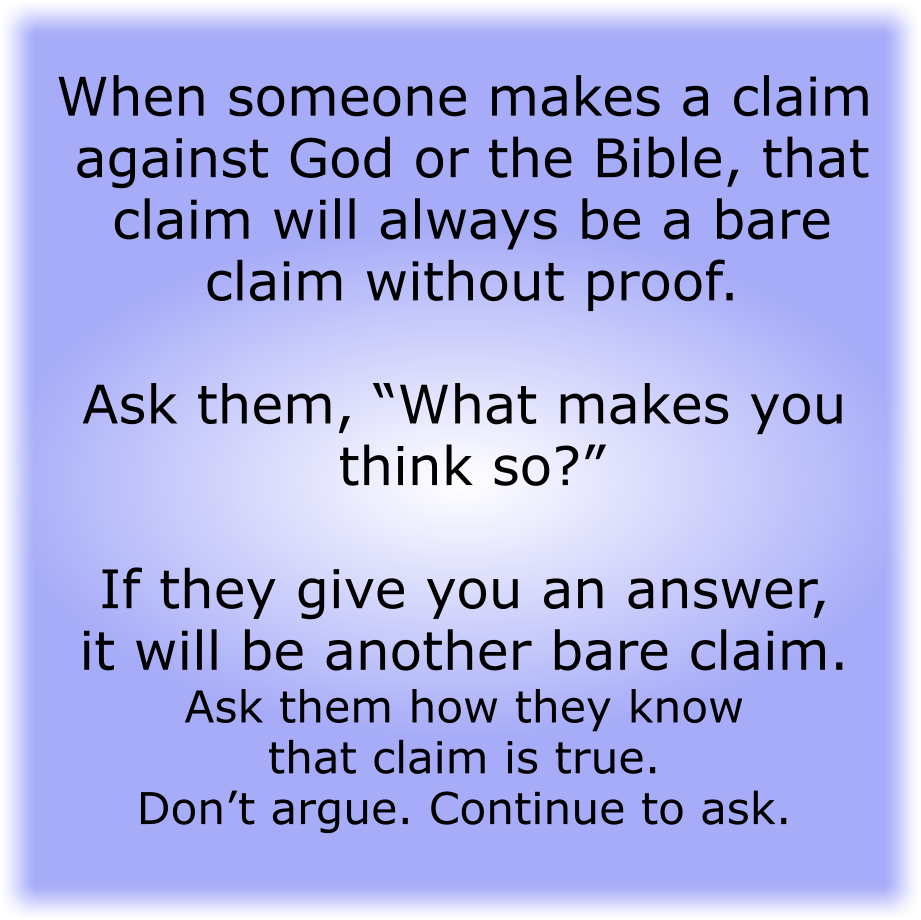
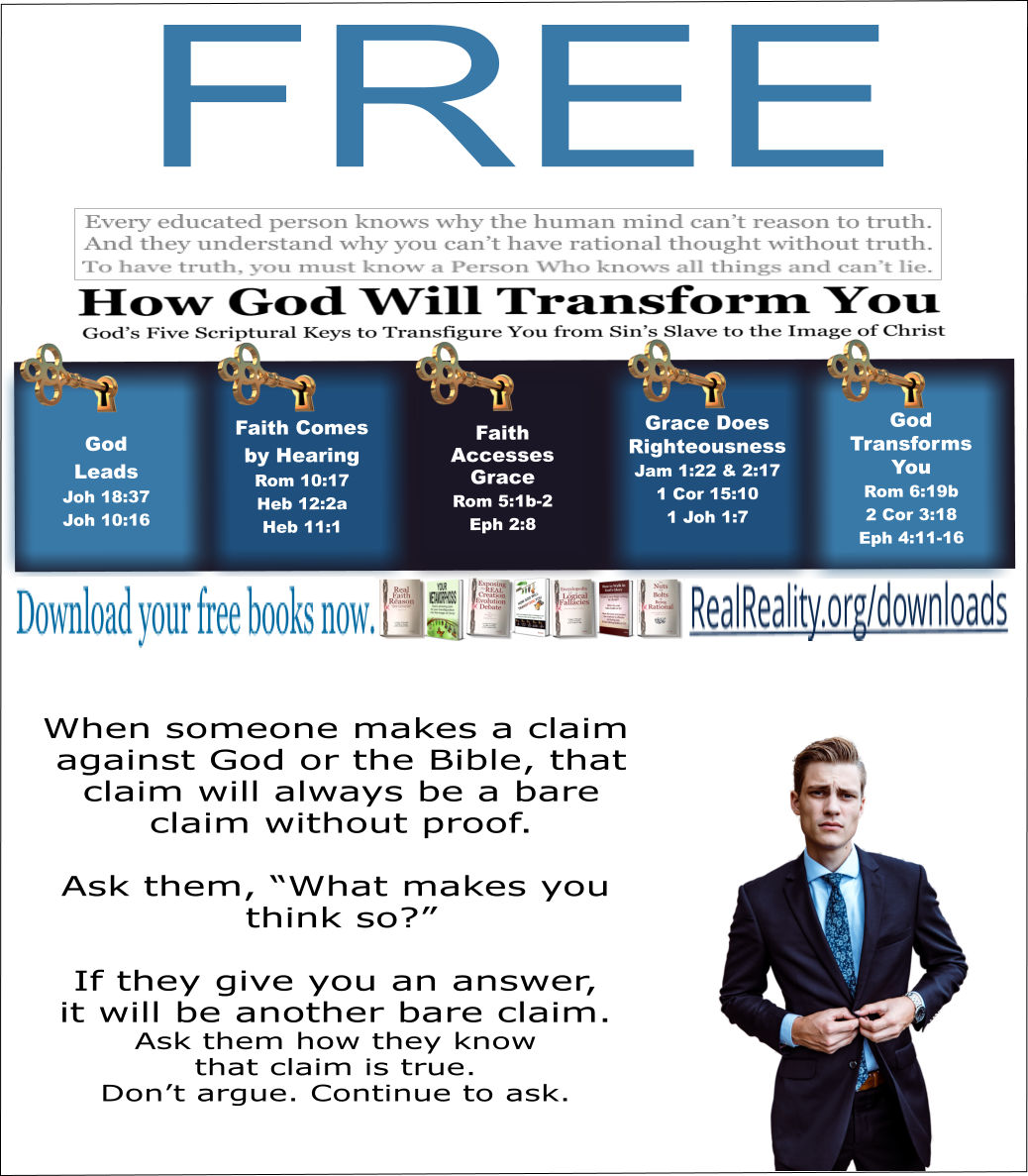
When someone makes a claim against God or the Bible, that claim will always be a bare claim without proof. Ask them, “What makes you think so?” If they give you an answer,
it will be another bare claim. Ask them how they know that claim is true. Don’t argue. Continue to ask. I can assure you that, regardless of how confident they seem, they won’t be able to give you a solid reason for their animosity toward God or the Bible.
Many atheists are well aware of this problem and have come up with a clever way around it. It’s called “shifting the burden of proof.” They say, “I’m not making any claims. (That’s a lie) I’m just saying I don’t believe you when you say God exists. (It might be a similar statement.) You have the burden of proof to prove God to me.
This is a trap. You might mention the First and Second Laws of Thermodynamics or the Law of Cause and Effect or any other evidence that God gives us in the natural world around us. No matter what evidence you may present, the atheist can say, “That doesn’t prove anything to me. Give me real evidence.” Do not argue. No one can prove anything to anyone who doesn’t want to be persuaded. Only God can soften a hardened heart. Do not argue. You know God exists because you know Him through Jesus Christ. You have a personal relationship. You can’t prove that relationship to anyone, but God has proven it to you. You hear His voice. And you know the Bible is reliable because the Holy Spirit confirms to you that it is reliable. God also reveals that the atheist already knows God exists. Romans, the first chapter, tells us “They are without excuse.” Be led by the Holy Spirit and only say the words the Holy Spirit gives you to say. Then, you will have been obedient and done what you were supposed to do.
FREE: Exposing the REAL Creation-Evolution Debate
https://RealReality.org/Exposing_the_REAL_Creation-Evolution_Debate_-_Scientia.pdf
#SonsOfGod #SpiritualTransformation #HearingGodsVoice #Manifestation